
The Anthropomorphic Inflection: A Comprehensive Analysis of Physical AI, the Robot Data Gap, and the Commercial Realities of Humanoid Systems

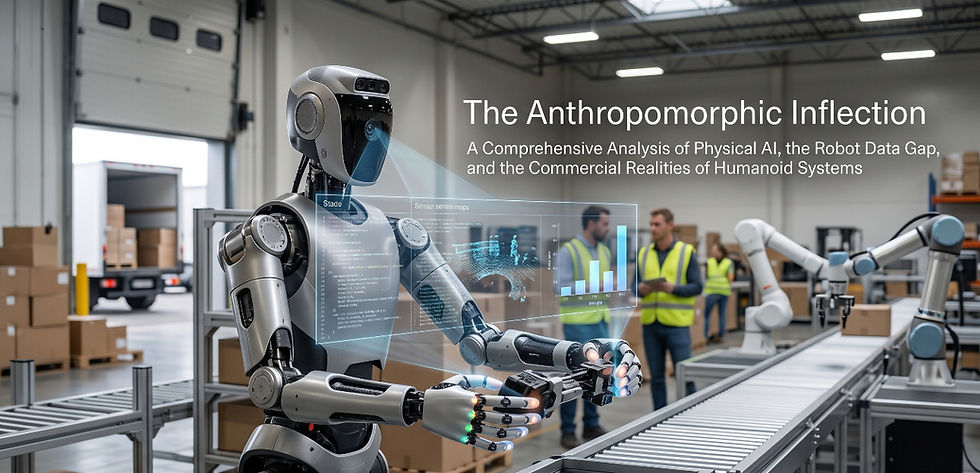
The emergence of humanoid robotics as a credible industrial and commercial category represents a fundamental paradigm shift in the intersection of artificial intelligence and mechanical engineering. For decades, the field of robotics was defined by task-specific machines operating in highly structured environments, where safety was maintained through physical separation from human workers. However, the current technological epoch is characterized by the rise of "Physical AI," a conceptual framework where intelligence is not an abstract computational process but an emergent property of real-world interaction between an embodied agent and its environment. This transition is driven by a convergence of severe demographic pressures, including a global labor shortage that threatens to leave millions of manufacturing and logistics positions vacant, and unprecedented breakthroughs in generative artificial intelligence and world models. The following report provides an exhaustive analysis of the technical, economic, and geopolitical forces shaping the humanoid robotics market as of mid-2025, evaluating the persistent tension between industry hype and the practical realities of deployment.
The Conceptual Foundations of Physical AI and Embodied Cognition
The transition from "digital AI," which operates primarily within the realms of symbolic reasoning and pixel manipulation, to "Physical AI" represents a new scientific frontier. In this paradigm, cognition is materially instantiated within a cyber-physical substrate capable of autonomous, safe, and ethically aligned interaction. Unlike Large Language Models (LLMs) that draw upon vast repositories of text to simulate human-like conversation, Physical AI systems must function through closed perception-decision-action feedback loops governed by the unrelenting laws of physics, causality, and thermodynamic constraints. This represents a shift from machines that merely interpret reality to agents that participate in it, where every sensory input reshapes the context for subsequent action.
The significance of this embodiment cannot be overstated. By possessing a physical body that mirrors the human form, these robots can navigate environments already optimized for human workers, utilizing existing tools, stairways, and workstations without the need for prohibitively expensive facility retrofitting. This "human-compatibility" allows for the integration of general-purpose agents into workflows that were previously considered too unstructured for traditional automation. The goal is to move beyond the single-purpose robots of the past toward "general-purpose tools" that can theoretically load a dishwasher in a home environment or operate an assembly line in an automotive plant with equal proficiency.
Technical Attribute | Digital AI (Disembodied) | Physical AI (Embodied) |
Primary Domain | Symbolic/Static Data (Text, Images) | Dynamic Spatiotemporal Environments |
Feedback Loop | Open/Prompt-Based | Closed Perception-Action Loops |
Constraints | Algorithmic/Logic-Based | Physical Laws, Gravity, Friction |
Learning Source | Internet-Scale Human Text/Media | Sensor Fusion (Vision, LiDAR, Haptics) |
Primary Goal | Information Processing | Material Interaction and Task Execution |
The Robot Data Gap: The 100,000-Year Bottleneck
While the potential for Physical AI is immense, the industry faces a foundational challenge often referred to as the "robot data gap". Professor Ken Goldberg of UC Berkeley has articulated this challenge as a "100,000-year data gap," highlighting the disparity between the training data available for LLMs and the data available for robotic manipulation. LLMs like GPT-4 are trained on trillions of words—a volume of text that would take a human reader approximately 100,000 years to consume. In contrast, the physical experiences of robots are not recorded in any central repository of comparable scale.
Robots require high-quality, 3D motion data to learn tasks that humans find intuitive, such as picking up a delicate glass or folding a piece of fabric without "squishing" it. While researchers have explored mining 2D video data from platforms like YouTube, translating those pixels into the precise motor commands and force-feedback requirements needed for 3D manipulation is technically arduous. Furthermore, 2D video lacks the fine-grained haptic information essential for understanding how much pressure to apply to an object.
To address this gap, the industry has adopted several innovative data-acquisition strategies. Teleoperation, where human operators remotely control robots using motion-capture suits or VR interfaces, allows for the collection of direct action-perception data. However, this method is fundamentally limited by its linear nature; one hour of human demonstration produces only one hour of robotic training data. Consequently, companies are increasingly turning to high-fidelity simulators—digital twins of the physical world—to "bootstrap" robot learning. These simulators allow robots to practice movements millions of times in parallel, though the "sim-to-real" transfer remains a hurdle, as simulators often fail to capture the chaotic nuances of physical friction and material deformation.
Global Market Dynamics and the Economic Thesis
The economic valuation of the humanoid robot market is characterized by aggressive growth projections and massive capital deployment from global technology leaders such as Nvidia, OpenAI, Google, and Tesla. In 2025, the global market for humanoid robots was valued at approximately $4.89 billion, with some projections indicating it could reach $165.13 billion by 2034, reflecting a compound annual growth rate (CAGR) of 50.60%. Other long-term assessments from institutions like Morgan Stanley suggest that the humanoid ecosystem could eventually exceed $5 trillion by 2050, as these machines begin to assume a significant portion of the global labor burden.
The primary driver for this investment is the worsening global labor crisis. In industrial economies, aging populations and a declining workforce have created a demographic reckoning. It is estimated that nearly 8 million manufacturing jobs could go unfilled by 2030, with 2 million vacancies projected in the United States alone by 2033. This shortage is coupled with rising labor costs; for instance, EU labor costs rose 5% between 2023 and 2024. Humanoid robots, with a projected unit cost falling toward $16,000 to $30,000, are reaching an economic crossover point where they become more cost-effective than human labor, particularly in high-churn or dangerous roles.
Market Metric | 2025 Value/Status | 2030/2034 Projection |
Global Market Size | $4.89 Billion | $165.13 Billion (2034) |
Annual Installations | ~16,000 Units | 115,000+ Units (2027 alone) |
Unit Cost (Mid-Range) | $13,500 - $30,000 | ~$16,000 (Mass Production) |
Dominant Region | Asia Pacific (42.6% share) | Global Distribution |
Core Industries | Logistics, Manufacturing | Service, Healthcare, Household |
The competitive landscape is currently bifurcated between the "vertical integration" model and the "ecosystem" model. Tesla represents the former, aiming to build both the robotic hardware (Optimus) and the underlying AI "brain" in-house, leveraging its experience in electric vehicle manufacturing and autonomous driving. Conversely, the rest of the industry is gravitating toward an "Android-like" model, where hardware manufacturers such as Agility Robotics, Figure AI, and 1X develop sophisticated bodies while utilizing generalized foundation models provided by companies like Nvidia (Project GR00T), Google, and OpenAI.
Geopolitical Stakes and China’s Strategic Dominance
China has identified humanoid robotics as a critical pillar of its "Made in China 2025" (MIC2025) industrial policy, viewing the sector as a means to transform itself from a hub of low-value assembly into a global high-tech superpower. Since the initiative's inception in 2015, the Chinese government has invested heavily in the robotics supply chain, committing an estimated $140 billion toward emerging technologies in 2025 alone. This state-led strategy has yielded significant results; as of 2024, China installed 295,000 new industrial robots—more than the rest of the world combined.
A key advantage for China lies in its vertically integrated manufacturing ecosystem. Chinese firms have successfully localized critical components that were previously dominated by international competitors, such as the compact precision gears and harmonic reducers necessary for robotic joints. This localized supply chain has enabled the emergence of over 140 Chinese humanoid companies, with firms like AgiBot shipping thousands of units from facilities in Shanghai. China’s roadmap aims for mass production of humanoid robots by the end of 2025 and a fully matured supply chain by 2027.
However, this rapid ascent has triggered a geopolitical backlash. The United States and Europe have expressed concerns regarding global market distortion, intellectual property theft, and the transfer of dual-use technologies with military applications. In response, Western governments have increasingly emphasized the need for self-sufficiency in core materials and semiconductor technology to prevent over-dependence on Chinese robotic exports.
Industrial Deployment and the Reality of Logistics
The transition of humanoid robots from laboratory demonstrations to "live" industrial operations is being led by the logistics and automotive sectors. Companies such as GXO Logistics, BMW, and Mercedes-Benz are conducting large-scale pilots to evaluate the efficacy of these machines in real-world environments.
Case Study: GXO Logistics and the SPANX Facility
GXO Logistics, a leader in contract logistics, has signed the industry's first formal commercial deployment of humanoid robots through a Robots-as-a-Service (RaaS) agreement with Agility Robotics. At their facility in South Carolina, GXO is utilizing the "Digit" robot to move totes from autonomous mobile robots (AMRs) to conveyors. This specific use case highlights the "multipurpose" nature of humanoids; while a traditional conveyor or robotic arm is fixed, Digit can navigate the warehouse floor, operate in human-centric spaces, and transition between different tasks as operational needs change.
Despite the success of these pilots, operational challenges remain significant. In warehouse settings, humanoids have been observed "dropping" or "damaging" products due to a lack of sophisticated tactile feedback. Unlike human workers, who can intuitively adjust their grip strength based on the perceived fragility of an item, current robots often struggle with "adversarial objects" such as empty wrappers or delicate eyeglasses. Furthermore, the speed of these robots is currently slower than that of a proficient human worker, and their battery life—averaging between 90 minutes and 4 hours—necessitates frequent rotations or autonomous docking for recharging.
Robot Model | Developer | Form Factor | Primary Application |
Digit | Agility Robotics | Bipedal | Logistics/Warehouse Totes |
Optimus | Tesla | Bipedal | Factory Assembly/General Task |
Figure 02 | Figure AI | Bipedal | Automotive Handling (BMW) |
Neo Beta | 1X Technologies | Bipedal | Domestic Assistance/Laundry |
Apollo | Apptronik | Bipedal | Heavy Material Transport |
Reflex Robot | Reflex Robotics | Wheeled/Humanoid | Omni-channel Fulfillment |
Human-Robot Interaction and the Psychology of Anthropomorphism
The decision to build robots in the human image is as much about psychology as it is about mechanics. "Anthropomorphism"—the attribution of human traits to non-human entities—plays a dual role in the integration of robots into the workplace and society. On one hand, humanoid robots can enhance user engagement and trust, particularly in service industries such as healthcare, elderly care, and hospitality. For instance, studies have shown that female-gendered robots are often perceived as "warmer" and are more effective in caregiving contexts, while male-gendered robots are viewed as more authoritative and suitable for technical roles.
However, the "Uncanny Valley" effect remains a formidable barrier. When a robot appears nearly human but fails to replicate human movement or emotional nuance perfectly, it often provokes visceral aversion in human observers. In the workplace, this is compounded by concerns over job security. Research indicates that employees perceive highly anthropomorphic robots as a greater threat to their jobs than mechanical-looking machines. This "job-security threat" can lead to lower morale, increased resistance to technology adoption, and even the signing of petitions against robotic integration. To combat this, some firms are choosing "lower anthropomorphism" designs—such as robots without realistic faces or with clearly mechanical limbs—to reduce the perceived threat and foster a sense of "augmentation" rather than "replacement".
Technical Hurdles: Dexterity, Power, and Safety
The road to a fully autonomous, general-purpose humanoid is paved with engineering obstacles that have persisted for decades. While locomotive capabilities have advanced significantly—with robots like Boston Dynamics’ Atlas performing parkour and Agility’s Digit navigating stairs—fine motor dexterity remains the "holy grail" of robotics.
Tactile Sensing: Most current humanoid hands are "blind" to the touch. They rely almost entirely on computer vision to guide their movements, which is insufficient for tasks that require delicate pressure, such as tying shoelaces or handling a soft piece of fruit.
Actuator Efficiency: To achieve human-like movement, robots require high-torque actuators that are both powerful and compact. However, these components generate significant heat and consume large amounts of electricity, which limits the robot's operational window.
Safety and Compliance: Traditional industrial robots are kept in cages. Humanoids, by design, must operate in shared spaces. This requires "cobot" technology—advanced sensors and software that can detect human presence and immediately halt or adjust motion to prevent injury.
Battery Density: The 90-minute operational limit mentioned in several reports is a major bottleneck for 24/7 industrial operations. While "Robots-as-a-Service" models account for this by cycling units, the long-term goal is a shift toward solid-state batteries or more efficient energy-management systems.
Future Outlook: The Scaling Phase (2025–2030)
As of 2025, the humanoid robotics industry is transitioning from "Level 0" (no autonomy/pure teleoperation) toward "Level 1" and "Level 2" autonomy, where robots can perform repetitive tasks with minimal human intervention. Analysts predict that "Humanoid Version 1.0"—characterized by bipedal mobility and dual-arm high-degree-of-freedom hand structures—will enter mass production after 2029 as hardware costs continue to plummet.
The narrative of the next five years will be defined by the "flywheel effect." As more robots are deployed in controlled pilots, the volume of real-world interaction data will grow exponentially. This data will feed back into robotic foundation models, leading to rapid improvements in dexterity and spatial reasoning. By 2030, the industry expects a shift from single-purpose pilots to multi-purpose deployments, where a single robot can transition from unloading a truck to inspecting quality on an assembly line without specialized reprogramming.
The ultimate vision—robots in every home and hospital—remains decades away, contingent on solving the data gap and achieving a level of common-sense intelligence that allows for safe operation in the chaotic, unstructured environment of human daily life. Until then, the "humanoid revolution" will continue its steady march through the corridors of factories and the aisles of warehouses, driven by the inescapable reality of a shrinking global workforce and the relentless progress of Physical AI.
Synthesis of Findings and Strategic Recommendations
The exhaustive analysis of the humanoid robotics landscape reveals a sector at a critical juncture. The promise of Physical AI has attracted unprecedented capital and talent, yet the engineering reality remains tethered to fundamental challenges in data acquisition and hardware durability. For industrial stakeholders, the following strategic insights are paramount:
Prioritize Task-Specific Success over General-Purpose Hype: While the vision of a generalist robot is compelling, the most immediate value is found in "Humanoid Version 1.0" systems that address specific, repetitive labor shortages in logistics and automotive manufacturing.
Infrastructure for Data Collection is the Competitive Moat: The companies that will dominate the next decade are not just those with the best hardware, but those that build the most robust "data flywheels," capturing millions of hours of real-world interaction data to bridge the 100,000-year gap.
China’s Manufacturing Lead Requires Western Collaboration: The vertical integration of the Chinese supply chain makes them the current leader in hardware cost-efficiency. Western firms must balance the need for domestic security with the reality of China's dominance in robotic component manufacturing.
Human Factors are the Ultimate Integration Barrier: Technical success does not guarantee organizational success. Addressing the psychological "job-security threat" through transparent augmentation strategies and moderate-anthropomorphism designs is essential for workplace harmony.
The humanoid robotics revolution will not resemble the sudden, digital explosion of generative AI chatbots. Instead, it will be a deliberate, hardware-intensive slog, characterized by incremental gains in dexterity and battery life, and governed by the recursive feedback between digital intelligence and physical matter. In this "Red Queen's Race," the industry must continue to innovate just to keep pace with the mounting demographic and economic pressures of the twenty-first century.


Comments