
The 2026 Strategic Horizon: An Exhaustive Analysis of the Top 10 Transformative Technologies Reshaping Global Industry, Governance, and Society


Executive Summary: The Intelligence Supercycle Enters Execution Mode
The trajectory of technological evolution is rarely linear; it moves in punctuated equilibria—periods of rapid, chaotic innovation followed by phases of consolidation and pragmatic execution. As the global economy approaches 2026, we are witnessing the stabilization of the "Intelligence Supercycle." The speculative fervor that characterized the early 2020s—dominated by the initial awe of Generative AI—has transitioned into a rigorous demand for tangible, scalable, and secure industrial utility. The technologies defining 2026 are not merely iterative upgrades to existing software or hardware; they represent fundamental architectural shifts in how humanity computes, trusts, manufactures, and sustains itself.
This report provides an expert-level, exhaustive dissection of the ten most critical technology trends that will define the geopolitical and industrial reality of 2026. These trends are not isolated vectors; they are deeply interwoven, forming a complex lattice of dependencies. For instance, the deployment of Physical AI (robots) is contingent upon the energy efficiency of Neuromorphic Computing, which in turn requires Green Nitrogen systems to power the sustainable agriculture that feeds the human workforce managing these machines. Similarly, the Agentic AI systems orchestrating global supply chains cannot function without the trust layer provided by Digital Provenance and Post-Quantum Cryptography.
Our analysis categorizes these ten technologies into three strategic themes that dominate the 2026 landscape:
The Architect: Technologies that rebuild the foundational substrates of the digital world to ensure security, sovereignty, and scalability (Post-Quantum Cryptography, Neoclouds, Digital Provenance).
The Synthesist: The orchestration of autonomous intelligence to execute complex, multi-step workflows without human intervention (Agentic AI, Domain-Specific Models, 6G/NTN).
The Vanguard: Innovations that push the boundaries of physical reality, merging the biological and the mechanical (Physical AI, Neuromorphic Computing, Structural Energy, Green Nitrogen).
By 2026, the gap between "digital transformation" and "AI-native survival" will have closed. Organizations that treat these technologies as optional experiments face existential obsolescence, while those that align their operational backbones with these trajectories position themselves to capture a share of a multi-trillion-dollar redistribution of market value.
1. Agentic AI and Multi-Agent Ecosystems: The Shift from Conversation to Execution
The year 2026 marks the definitive historical pivot from Generative AI (GenAI)—which creates content—to Agentic AI, which executes actions. In the preceding years (2023-2025), AI was primarily a "copilot," a passive assistant waiting for human prompts to summarize text or generate code. In 2026, AI becomes a "coworker," capable of independent decision-making, long-horizon task planning, and autonomous error correction. This shift represents the single most significant productivity multiplier in the modern economic era.
1.1 The Operational Mechanics of Agentic Systems
To understand the magnitude of this shift, one must distinguish the architecture of an "agent" from a standard Large Language Model (LLM). An LLM is a probabilistic engine designed to predict the next token in a sequence. An agent, however, creates a cognitive loop: it perceives an objective, reasons through a plan, utilizes external tools (such as APIs, web browsers, or robotic controls), executes actions, and—crucially—evaluates the outcome to iterate if necessary.
In 2026, the focus has moved beyond single agents to Multi-Agent Systems (MAS). In these ecosystems, specialized agents collaborate to solve problems that are too complex for a single model to handle without "hallucinating" or losing context. This mimics human organizational structures.
The Decomposition of Labor: Instead of asking one AI to "write software," a MAS deployment assigns a Product Manager Agent to define the scope, a Coding Agent to write the syntax, a Reviewer Agent to check for bugs and security vulnerabilities, and a DevOps Agent to deploy the code.
Adversarial Collaboration: These agents can be designed to critique each other. A "Red Team" agent might actively try to break the plan proposed by a "Strategy" agent, thereby hardening the final output before it ever reaches a human supervisor. This internal validation loop significantly reduces error rates compared to monolithic models.
1.2 The "Synthesist" Economy and Workforce Disruption
The rise of agentic workflows introduces the concept of the "Synthesist" organization, where human value is created not by doing the work, but by orchestrating the autonomous entities that do. This precipitates a profound transformation in the labor market. Research indicates that by 2026, agentic systems will make approximately 15% of enterprise decisions autonomously, a staggering rise from near-zero adoption just two years prior.
This automation encroaches on cognitive labor previously deemed safe. Reports estimate that by 2026, AI agents could displace or significantly alter 85 million jobs, particularly in retail, administration, and data processing. However, this is not a simple story of job loss. A paradox emerges: while displacement occurs, the demand for "human-in-the-loop" oversight creates a talent shortage. The time to fill developer positions is expected to double in 2026 because the skill set has shifted from "writing code" to "debugging agentic interactions"—a far more complex task involving non-deterministic behaviors.
The Reskilling Imperative: Organizations are responding with aggressive reskilling. Approximately 81% of HR chiefs plan to reskill employees for the "digital labor" era. The focus is shifting to soft skills—relationship building, strategic oversight, and ethical judgment—as these remain the few areas where humans outperform agents.
1.3 The Governance and Reliability Crisis: "Agent Washing"
As agents move from pilot programs to production, 2026 is also the year of the "Agentic Reality Check". Organizations face significant challenges in governance. When an autonomous agent negotiates a supply chain contract that results in a financial loss, liability becomes opaque. Is the fault with the prompt engineer, the model developer, or the agent's runtime environment?
Forrester predicts that 40% of agentic AI projects may be canceled by 2027 due to escalating costs and inadequate risk controls. This high failure rate is exacerbated by "Agent Washing"—a marketing phenomenon where vendors rebrand legacy automation scripts or basic chatbots as "autonomous agents" to capitalize on the hype. True agency requires reasoning and adaptability, not just rigid if-then scripting.
Feature | Generative AI (2023-2025) | Agentic AI (2026+) |
Primary Function | Content Generation, Summarization | Task Execution, Decision Making |
Interaction Model | Chat/Prompt-Response | Autonomous/Goal-Directed |
Collaboration | Single User-to-Model | Multi-Agent Swarms |
Error Handling | Human Review Required | Self-Correction/Iterative Loops |
Economic Impact | Efficiency (Doing tasks faster) | Agency (Doing tasks independently) |
Key Risk | Hallucination | Unintended Action/Liability |
Strategic Implication: By 2026, competitive advantage belongs to firms that establish "Agent Operations" (AgentOps) frameworks. These are control planes that monitor agent behavior, enforce spending limits, and provide a "kill switch" for runaway processes. The era of unsupervised experimentation is over; the era of governed autonomy has begun.
2. Physical AI and the Embodiment of Intelligence
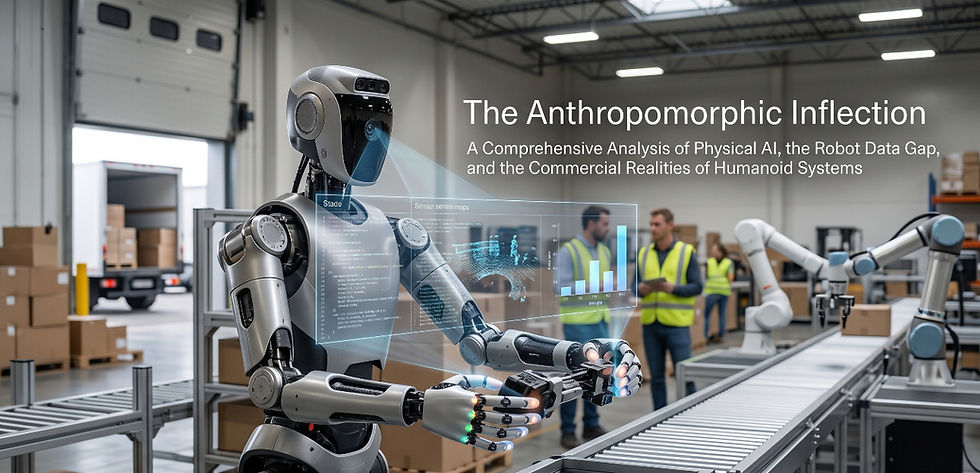
Physical AI represents the convergence of advanced AI models with physical hardware, enabling machines to perceive, reason, and act in the physical world with a level of dexterity and adaptability previously reserved for biological organisms. In 2026, this trend manifests primarily through the maturation of humanoid robotics and advanced autonomous systems in industrial settings.
2.1 The "AlphaGo Moment" for Robotics
Just as AlphaGo demonstrated that AI could master complex strategy, 2026 is anticipated to be the "AlphaGo moment" for physical dexterity. Historically, robots were "blind" and "deaf," requiring rigid programming and structured environments (like safety cages in automotive factories). Physical AI decouples hardware from hard-coded software.
Foundation Models for Robotics: The breakthrough driving this in 2026 is the use of "World Models"—AI systems that understand physics, causality, and object permanence. These models allow robots to learn tasks via reinforcement learning in virtual simulations (known as "Sim-to-Real" transfer). A robot can practice folding a shirt or assembling a circuit board millions of times in a virtual "gym" before attempting it in the real world, compressing years of training into days.
Startups and major tech firms are capitalizing on this. Companies like Bedrock Robotics (autonomous construction), Blue Water Autonomy (vessels), and Diligent Robotics (hospital service) are moving from prototypes to commercial fleets. This is not just about replacing human muscle; it is about bringing intelligence to the edge of the network.
2.2 Industrial and Domestic Deployment: From Automated to Autonomous
By 2026, the market will see the first scalable deployments of humanoid robots in labor-intensive industries. Manufacturing robots will transition from "automated" (repeating a script) to "autonomous" (solving problems).
Scenario: A sensor on a CNC machine detects a vibration anomaly. In the old paradigm, the machine would eventually fail. In the 2026 paradigm, a Physical AI agent detects the anomaly, autonomously queries the production schedule, identifies a maintenance window, re-routes production to a secondary line, and orders the replacement part—all before the machine fails.
The Domestic Front: LG and other consumer electronics giants are debuting humanoid concepts for the home, such as the LG CLOiD. These robots utilize "dynamic" kinematics to navigate cluttered human spaces, moving beyond the simple vacuuming of previous generations to perform complex manipulation tasks.
2.3 Safety, Ethics, and The "Uncanny Valley"
The proliferation of Physical AI introduces acute safety challenges. The European Union's AI Act, which becomes fully applicable in mid-2026, sets strict guidelines for high-risk AI systems, including those embedded in machinery.
Lone Worker Safety: A major focus in 2026 is the safety of "lone workers" (utility repair technicians, home healthcare aides) who now work alongside autonomous machines. New safety protocols and wearable technologies are required to prevent accidents caused by algorithmic unpredictability.
Human Acceptance: The "human acceptance" factor remains a barrier. While workers may accept a robotic arm, the introduction of bipedal, anthropomorphic machines creates psychological friction. Organizations must manage the cultural integration of the "hybrid human-silicon workforce" to prevent sabotage or rejection of the technology. This is described as the "Uncanny Valley" of the workplace, where machines are human enough to be unsettling but not human enough to be trusted socially.
3. Neuromorphic Computing: Solving the AI Energy Paradox
As AI models scale exponentially, their energy consumption has become unsustainable. By 2026, the electricity consumption of data centers is projected to double, reaching over 1,000 terawatt-hours globally—roughly equivalent to the consumption of Japan. This energy crisis drives the urgent adoption of Neuromorphic Computing.
3.1 Biomimetic Architecture: Breaking the Von Neumann Bottleneck
Traditional computing follows the Von Neumann architecture, where processing units (CPUs/GPUs) and memory are separated. Data must travel back and forth between them, creating a "bottleneck" that consumes vast amounts of energy and induces latency. This architecture is fundamentally inefficient for AI workloads that require massive parallel processing.
Neuromorphic chips mimic the human brain's biological structure. They integrate memory and processing into "neurons" and "synapses" on the same silicon substrate. Crucially, they utilize Spiking Neural Networks (SNNs). Unlike standard chips that burn energy continuously (like a metronome), SNNs are event-driven: portions of the chip remain dormant until a specific "spike" of data requires processing.
The Efficiency Gap: The human brain processes complex sensory information using approximately 20 watts of power. A conventional supercomputer requires 21 megawatts to simulate similar neural activity. Neuromorphic chips aim to bridge this six-order-of-magnitude efficiency gap, offering up to 1,000x reductions in power consumption for specific workloads.
3.2 The 2026 Commercialization Inflection
While neuromorphic computing has been a research niche for decades, 2026 is the year it exits the lab. Intel's Hala Point, a neuromorphic system with 1.15 billion neurons, and systems from startups like SpiNNcloud are entering commercial pre-sales and pilot programs.
Drivers for 2026 Adoption:
Edge AI & Robotics: Autonomous vehicles and drones have strict power budgets. Neuromorphic chips allow these devices to process visual and sensory data locally without draining batteries, enabling "always-on" intelligence.
Sustainability Mandates: With regulatory pressure to reduce the carbon footprint of AI (such as the EU's directives on data center efficiency), companies are forced to explore non-silicon-standard architectures.
Real-Time Processing: For Physical AI, the latency of sending data to the cloud is dangerous. Neuromorphic chips provide the nanosecond-speed processing required for real-time robotic reflexes.
Strategic Insight: The transition to neuromorphic computing is not a wholesale replacement of GPUs. GPUs will remain dominant for model training (which relies on massive parallel matrix multiplication). Neuromorphic chips will dominate inference and sensory processing. This creates a bifurcated hardware market in 2026: massive GPU clusters for creating intelligence, and neuromorphic chips for deploying it.
4. Green Nitrogen Fixation: Decarbonizing the Food Supply
Agriculture consumes vast amounts of energy, largely due to the production of synthetic nitrogen fertilizers. The industry currently relies on the Haber-Bosch process, a century-old method that uses high heat, high pressure, and hydrogen derived from fossil fuels (methane). This single industrial process accounts for 1-2% of global energy consumption and massive CO2 emissions. In 2026, Green Nitrogen Fixation emerges as a critical technology for sustainable food security.
4.1 Plasma and Electrochemical Solutions
In 2026, we see the scalability of Non-Thermal Plasma (NTP) and electrochemical reactors. These technologies utilize renewable electricity to break the strong triple bond of atmospheric nitrogen (N2) and combine it with hydrogen (from water electrolysis) to create ammonia or nitrates.
Mechanism: Unlike Haber-Bosch, which requires massive centralized plants, plasma reactors can be modular. They generate "lightning in a bottle"—using electric fields to ionize air and create reactive nitrogen species. This allows for "Fertigation": the on-site production of liquid fertilizer at the farm level using only air, water, and sunlight.
4.2 Economic and Environmental Resilience
The World Economic Forum identifies Green Nitrogen as a top emerging technology for 2025-2026 because it addresses two crises simultaneously:
Climate Crisis: It decouples food production from fossil fuels.
Supply Chain Security: The geopolitical instability of the 2020s (e.g., the Ukraine war) exposed the fragility of global fertilizer supply chains, causing price spikes that threatened famine in vulnerable regions. Decentralized green nitrogen immunizes farmers against these global shocks.
2026 Market Dynamics: Pilot programs, such as those funded by Minnesota's agricultural research grants, are moving from lab benches to field trials in 2026. The cost of green ammonia is stabilizing, driven by falling renewable energy costs (solar/wind). By 2026, green ammonia is expected to become cost-competitive with fossil-fuel-derived ammonia in regions with high natural gas prices or carbon taxes. The market for green nitrogen fixation is projected to see a CAGR of over 30% as these pilots prove their unit economics.
5. Post-Quantum Cryptography (PQC): The "Q-Day" Preparation
The threat of quantum computers breaking current public-key encryption (RSA, ECC) looms over the digital world. While a cryptographically relevant quantum computer may not fully exist in 2026, the threat of "Harvest Now, Decrypt Later" (HNDL) attacks forces immediate action. Adversaries are stealing encrypted data today to decrypt it years from now when quantum hardware matures. This makes PQC an immediate necessity, not a future luxury.
5.1 The 2026 Migration Mandate
The year 2026 is a critical hard deadline in global cybersecurity roadmaps:
EU Compliance: The NIS Cooperation Group has set the end of 2026 as the deadline for Member States to begin the transition to PQC and for organizations to complete their "cryptographic inventory".
North American Mandates: The Government of Canada mandates the development of initial departmental PQC migration plans by April 2026. Similar timelines are mirrored in US federal guidance following NIST's standardization of algorithms like ML-KEM (Kyber) and ML-DSA (Dilithium).
5.2 The "Y2Q" Challenge and Performance Costs
Migrating to PQC is significantly more complex than a standard software update. It is often compared to "Y2K" but for cryptography—"Y2Q." It requires replacing fundamental security certificates, hardware security modules (HSMs), and updating legacy codebases that have hardcoded encryption standards. Cryptographic Agility—the ability to swap encryption algorithms without breaking the system—is the primary KPI for CISOs in 2026.
The Performance Trade-off: PQC algorithms introduce a "performance penalty." They generally require larger key sizes and more computational power than current standards.
Embedded Systems Risk: IoT devices, smart cards, and industrial sensors often lack the memory and processing power to handle PQC keys. This necessitates a hardware refresh cycle in 2026, driving costs up for manufacturers.
Network Latency: The larger packet sizes of PQC keys can slow down handshake protocols, impacting high-frequency trading and real-time communications.
Milestone | Action Required by 2026 |
Inventory | Identify all instances of public-key cryptography in the IT stack. |
Planning | Allocate budget for hardware upgrades (HSMs, Smart Cards). |
Testing | Pilot "Hybrid" schemes (combining Classical + PQC) to ensure backward compatibility. |
Vendor Risk | Audit supply chain partners for their PQC readiness. |
6. The Connectivity Revolution: 6G and Non-Terrestrial Networks (NTN)
While 5G deployment continues, 2026 is the year the foundation for 6G is formally laid, characterized by the seamless integration of terrestrial mobile networks with satellite constellations, known as Non-Terrestrial Networks (NTN).
6.1 3GPP Release 20 and the Path to Release 21
The telecommunications industry operates on precise standardization cycles led by the 3GPP.
Release 20 (2025-2027): This cycle is active in 2026, focusing on "5G Advanced." It bridges the gap to 6G by introducing AI/ML into the air interface and enhancing energy efficiency.
Release 21 (Defined in 2026): Crucially, by June 2026, the 3GPP will define the timeline and scope for Release 21, which will contain the first set of technical specifications for 6G. This makes 2026 the year 6G moves from concept to engineering standard.
6.2 Ubiquitous Connectivity via NTN
2026 will see the commercial maturity of "Direct-to-Cell" satellite connectivity. Unlike early proprietary implementations (e.g., Apple's emergency SOS), standards-based NTN allows standard smartphones to connect to Low Earth Orbit (LEO) satellites for data and voice without specialized hardware modifications. This effectively eliminates "dead zones" globally.
Impact: This integration is vital for logistics (tracking containers in the mid-ocean), agriculture (connecting sensors in remote fields), and automotive (over-the-air updates for autonomous vehicles in rural areas).
6.3 Security and Privacy in the 3rd Dimension
As networks expand to include satellites, drones, and high-altitude platforms, the attack surface expands three-dimensionally. 2026 research focuses heavily on "Trustworthy 6G."
Privacy Risks: The integration of NTN raises sovereignty issues. Data transmitted via satellite can bypass national firewalls and terrestrial jurisdiction, creating "data havens" in space. This complicates regulatory enforcement (e.g., GDPR) and necessitates new international frameworks for space-based data privacy.
Security Automation: The complexity of managing dynamic connections between fast-moving satellites and ground stations exceeds human capability. 6G networks in 2026 will increasingly rely on AI to detect jamming, spoofing, and eavesdropping attacks in real-time.
7. Digital Provenance and Preemptive Cybersecurity
In 2026, the distinction between "real" and "synthetic" becomes the central pillar of digital trust. With the proliferation of deepfakes and AI-generated disinformation, society faces the "Liar's Dividend"—the phenomenon where bad actors can dismiss authentic incriminating evidence (videos, audio) as deepfakes because the public no longer trusts their eyes or ears.
7.1 The C2PA Standard and Content Credentials
The Coalition for Content Provenance and Authenticity (C2PA) standard is expected to become the de facto "nutrition label" for digital content by 2026. This technology uses cryptographic metadata to securely record the origin and edit history of a file.
Adoption: By 2026, major camera manufacturers (Sony, Canon, Nikon) and software platforms (Adobe, Microsoft) will have integrated C2PA at the hardware and OS level. Content uploaded without these credentials will be flagged by social media platforms and browsers as "unverified" or "high risk."
Challenges: The barrier to adoption remains interoperability. If a C2PA-signed image is edited in a non-compliant app, the "chain of custody" breaks. 2026 will see a push for universal API standards to prevent this metadata stripping.
7.2 Deepfake Detection and the Arms Race
The market for deepfake detection is projected to grow to $15.7 billion by 2026. However, passive detection (analyzing pixels for artifacts) is becoming increasingly futile against rapidly evolving Generative Adversarial Networks (GANs). This necessitates a shift to Preemptive Cybersecurity.
Exposure Management: Preemptive security moves beyond reactive patching. It involves using AI to continuously simulate attacks on one's own infrastructure to identify vulnerabilities before adversaries do. By 2026, CIOs will prioritize "exposure management"—knowing where they are vulnerable—over simple "threat detection." Gartner forecasts that by 2030, preemptive solutions will account for half of all security spending, with 2026 being the pivot point for enterprise adoption.
7.3 AI Watermarking and Regulation
Governments worldwide are enforcing transparency. The EU AI Act and US executive orders encourage or mandate watermarking for AI-generated content. In 2026, we will see the deployment of "imperceptible" watermarks (modifying the frequency domain of images/audio) that survive compression and cropping. However, an adversarial industry of "watermark removal tools" will emerge, creating a perpetual cat-and-mouse game.
8. Structural Energy and Advanced Materials
In 2026, the boundary between "material" and "machine" blurs. Two key trends define this space: Structural Battery Composites and Programmable Matter.
8.1 Structural Battery Composites: The Chassis is the Battery
Traditionally, batteries are "dead weight"—heavy components that store energy but require a separate steel chassis to support them. Structural Battery Composites (SBCs) revolutionize this by integrating energy storage into the load-bearing structure itself.
Chemistry & Mechanics: These composites use carbon fiber as the negative electrode and a lithium iron phosphate-coated aluminum foil as the positive electrode, set in a structural polymer electrolyte. The material can carry mechanical loads (like a car door or roof) while storing energy.
2026 Impact: Toyota and other automotive giants have signaled the launch of next-generation EV architectures in 2026 that leverage advanced battery integration to reduce weight and extend range. The market for SBCs is projected to grow significantly, reaching multibillion-dollar valuations as they move from luxury prototypes to mass-market EV platforms.
8.2 Programmable Matter and 4D Printing
Programmable Matter refers to materials that can change their physical properties (shape, stiffness, optical qualities) in response to external stimuli (heat, light, moisture, magnetic fields). This is often achieved through 4D Printing (3D printing where the fourth dimension is time or activation).
Applications in 2026:
Self-Healing Infrastructure: Concrete infused with vascular networks of healing agents (bacteria or polymers) that autonomously repair cracks, reducing maintenance costs for bridges and roads.
Adaptive Aerodynamics: Automotive components (spoilers, vents) that morph their shape to optimize airflow based on speed, without the need for heavy, complex hydraulic actuators.
Smart Textiles: Clothing for military or consumer use that adjusts its thermal insulation properties based on ambient temperature.
The market for programmable matter in consumer products is forecast to grow from $1.7 billion in 2026 to over $6 billion by 2035, indicating that 2026 is the start of the commercial ramp-up.
9. The Neocloud and Sovereign AI Infrastructure
The dominance of the "Hyperscalers" (AWS, Azure, Google Cloud) is being challenged by the rise of the Neocloud. The insatiable demand for GPUs to train and run AI models has created a shortage that general-purpose clouds—designed for web hosting and database storage—struggle to meet efficiently.
9.1 The Rise of GPU-Native Clouds
Neoclouds (such as CoreWeave, Lambda) are specialized cloud providers built from the ground up for AI workloads. They offer bare-metal GPU access with high-performance networking (Infiniband), stripped of the legacy overhead and virtualization layers of general-purpose clouds.
Market Shift: Forrester predicts that in 2026, neoclouds will capture $20 billion in revenue, significantly eroding the hyperscalers' grip on the high-performance computing market. They are becoming the preferred infrastructure for training Large Language Models due to lower costs and specialized support.
9.2 Sovereign AI and Private Clouds
Geopolitical fragmentation drives the trend of "Geopatriation" and "Sovereign AI." Nations and large enterprises demand that their data and models reside within specific physical borders and legal jurisdictions to prevent espionage and ensure regulatory compliance.
Private AI: This drives a resurgence of Private Clouds. Approximately 15% of enterprises are expected to move sensitive AI workloads off public clouds and onto private infrastructure or sovereign neoclouds in 2026.
Infrastructure Rebuild: This requires a complete rebuild of the IT operating model. CIOs in 2026 must manage a "hybrid" portfolio: commodity workloads on public cloud, sensitive AI workloads on private/sovereign clouds, and high-performance training on neoclouds. This complexity drives the need for new "AI-Native" development platforms that can abstract this infrastructure complexity away from the developer.
10. Engineered Living Materials and Biotech Breakthroughs
Finally, 2026 sees the acceleration of Engineered Living Materials (ELMs) and advanced biotechnologies that treat biology as a programmable substrate. This sector moves beyond "biomimicry" (copying nature) to "bio-integration" (using nature as technology).
10.1 Engineered Living Therapeutics
ELMs are materials composed entirely or partly of living cells capable of self-replication and adaptation. In 2026, we see the clinical advancement of "Living Therapeutics"—bacteria or cells engineered to produce medicine inside the human body.
Mechanism: Instead of taking a pill, a patient might ingest an engineered probiotic that senses inflammation in the gut and synthesizes a therapeutic protein on demand. This provides continuous, localized treatment that traditional drugs cannot match.
Clinical Trials: By 2026, significant clinical trial results for these therapies (such as those for phenylketonuria or inflammatory bowel disease) are expected to read out, paving the way for regulatory approval.
10.2 In Vivo Gene Editing
The field of gene editing evolves from "ex vivo" (taking cells out, editing them, and putting them back—like current CAR-T therapies) to "in vivo" (editing cells directly inside the body).
CRISPR 2.0: Technologies like Lipid Nanoparticles (LNPs) are used to deliver CRISPR-Cas9 machinery directly to specific organs. In 2026, we expect to see the expansion of these therapies beyond rare diseases to more common conditions like high cholesterol (editing the ANGPTL3 gene), with companies like CRISPR Therapeutics and Verve Therapeutics leading the charge.
Ethical and Safety Barriers: This field faces the highest "trust barrier." Concerns about off-target edits, biosafety (engineered organisms escaping into the environment), and the ethics of permanent genetic modification remain intense. The "biosecurity" landscape in 2026 will be as active as the cybersecurity landscape, with new protocols required to contain and monitor these engineered biological agents.
Conclusion: The Imperative of 2026
The year 2026 is defined not by the novelty of these technologies, but by their integration. The synergy between these trends is where the true transformation lies:
Neuromorphic chips (Tech 3) enable Physical AI (Tech 2) to operate efficiently at the edge.
Agentic AI (Tech 1) orchestrates the supply chains for Green Nitrogen (Tech 4) and Structural Batteries (Tech 8).
Post-Quantum Cryptography (Tech 5) and Digital Provenance (Tech 7) provide the necessary trust layer for the 6G Networks (Tech 6) that connect it all.
Neoclouds (Tech 9) provide the compute power for the Biotech simulations (Tech 10) that design the next generation of materials.
For leaders and policymakers, 2026 requires a shift from "digital transformation" to "AI-native adaptation." The risks—ranging from the energy demands of supercomputing to the societal erosion caused by deepfakes—are as potent as the economic opportunities. Success in 2026 will belong to the Architects who build resilient foundations, the Synthesists who weave disparate agents into cohesive workflows, and the Vanguards who dare to physicalize intelligence.
Strategic Recommendations for 2026
Action Area | Recommendation |
Workforce | Audit workflows for "Agentic Potential." Move humans from task execution to agent orchestration. |
Security | Initiate the PQC migration immediately. Conduct a "cryptographic inventory" to meet 2026/2030 deadlines. |
Infrastructure | Diversify compute resources. Adopt Neoclouds for AI training to reduce dependency on Hyperscalers. |
Trust | Implement C2PA standards for all external corporate communications to immunize the brand against deepfake attacks. |
Sustainability | Pilot Green Nitrogen and Neuromorphic solutions to decouple growth from carbon and energy constraints. |


Comments